During the lengthy time since my last post my view of the future has grown increasingly cynical. Aside from the continued ignorance and carelessness from the masses, we are hit with more disturbing images such as those released by wiki-leaks. My attention has also been directed to look deeper into the matters of our current state of the world and what I have found is truly troublesome.
My disappointment with the mass media coverage of important matters was strengthened by their inability to uncover the truth of the events occurring in the wars that are being waged by the US. The horrible images that most of us by now has seen and that have widely been broadcasted led me to the documentary The War You Don't See. I found it disturbing (but not all that surprising) that governments all over the world are both directly and indirectly censuring and steering the mass media in order to suit their political agenda. Directly by either discrediting reporters that have a challenging view and or releaving them from their job. Indirectly by embedding them and in doing so having full control over the information that they plan on presenting to the world.
It turns out that the treachery runs even deeper. Before I go into that however I will spend some time discussing my view on conspiracy theory. Over the years I have been reading a lot of articles and gone through a lot of information, some of which at the time has seemed outrageous and was labeled by many as conspiracy theories. Without knowing exactly how it happened or when, a phobia of sorts has emerged in regards to conspiracy theories. As soon as something is labeled conspiracy theory, it is regarded with something close to disgust and the information is quickly dismissed and until a while back I was not much different. I could sometimes be fascinated by them but never took them seriously. What I am about to talk about is widely considered conspiracy theory. When looking at the information at hand, there was a lot that did not make sense and that is where the information that follows filled in some of the blanks.
As described earlier, the mass media is gaged by the politicians. Behind the politicians however there is another force that is governing. Most people are probably aware of the close ties that corporations and banks have with the government. In the US it is truly appalling, where politicians campaigns are financed heavily by different interest groups and this behavior puts these politicians under these interest groups thumb in a varying degree. This is only a small part of it however.
As people who are informed about the process of how money is created know, money is borrowed into existence. This is done by the central bank. In the US its called the Federal Reserve Bank or FED. What most people don't appreciate is that the FED is not a governmental entity but rather a private bank. A bank that is in turn funded and owned by other banks, such as JP Morgan. So when all the money that is printed by the FED goes out to the big banks in the form of stimulus or bailouts, they are in fact putting money into their own pockets. So far it can all be substantiated and could almost be considered common knowledge, or at least should be common knowledge. Behind the banks that are financing the FED there are a number of powerful and wealthy people and families. This is where the conspiracy comes in. Less corroborated information, rumors and speculation. Some say these people own more than half of the worlds wealth, that they have been profiting greatly from every war since before world war I and that for this reason they have also had a hand in creating them. Some say that they meet secretly to plan how to best continue controlling the worlds resources. Some say that they have enough power to appoint politicians and remove those that stand in their way. Facts mingled with rumors and speculation creates what many call conspiracy theories, and what is being uncovered is of the nature that hard proof is hard to come by and even dangerous to posses and spread.
In the times that we live in today, I believe it is important to be critical. Critical of the information that we find, but also critical of the information that we are being fed from sources that we normally would consider being trustworthy. The motive for spreading this information is not to create fear, panic or other destructive behavior. It is easy to feel that there is nothing that can be done about any of this, but the truth is that there is. In a variety of ways. Just by being informed you can make choices in the future based on this knowledge. You can opt out of the hamsterwheel that we are living in and choose to put your faith elsewhere. You can spread the information to your friends and beyond. You are not meant to do everything alone, that is why a community is so much stronger.
A thought provoking and mindblowing documentary about this can be find atleast in part and on youtube and is called Zeitgesit. A movement that has devoted time and money into uncovering the truth behind the economy and the world. It is up to you to choose what to believe and what to do with the knowledge that you come to possess.
In the list with links most of the information from all my posts can be found, a great tool for those that want deeper knowledge into any of the topics that are being brought up in the posts.

This blog was created with the purpose of building a stronger and more resilient community. By sharing information and knowledge about coming events, it is possible to be prepared for them. Generally people are uninterested in finding out about what is really going on, especially if it is bad news. Nevertheless, I feel obliged to share this information that is nowhere to be found in mainstream media.
Thursday, December 30, 2010


Wednesday, November 24, 2010
More and more signs
Since my last post, more and more signs are emerging, pointing to the harsh future that we are heading for. Currency wars are waging, countries like Russia and China have already begun experimenting with limiting of exports. Europe is in trouble with Ireland and Greece as the most prominent and immediate examples of countries that are so far gone that a default on their loans and its consequences are near. USA has begun its second round of quantitative easing, proving that the people in power are ever more clueless than before. This QE2 has stirred up a lot of insecurity and dismay from countries all over the world.
The response from governmental entities or the media are still shining with their absence and we are no way near a solution to our problems. On the contrary, the issues are stacking up and the situation becomes increasingly unstable. It wont take much now to push the situation over the edge, plunging us into unknown territory.
I have never had much hope that the situation will be resolved, and at this point even less. I had however hoped that there would be more of those that managed to opened their eyes, before it is too late. As pointed out by Chris Martenson, the International Energy Agency has for the first time pointed out that peak oil is happening and has in fact already happened. Somehow though, media such as the New York Times managed to repress the harsh facts of the IEA article and instead present an article themselves that looked more like the script for a press conference by an oil company rather than an investigative article from a respected (not any more) news paper. So its pretty clear that no matter however overwhelming the evidence of the coming crisis exists out there, not even when coming from governmental entities, it will never reach the public through politics or media.
Every day I think of new implications of what it means to be among the very few of those that have bothered to take this seriously and prepare. I see a future where, society finally realizes what is going on, they are going to blame politicians and who ever else that feels comfortable to blame and say that information of this did not exist, when it is in fact their own fault that they were to careless to find out more about it themselves. I see a future where relatives and friends will be in need of a piece of the provisions that I have carefully conserved, and how can I deny them? Provisions that would have lasted me and my closest for years would end up running out in mere months. I imagine how insecure the world will be when the law of the jungle and a situation of "every man for himself," "survival of the fittest" and "kill or be killed" arises. How I will have to fight for and protect what I have or possibly die trying. It makes me wonder, is there any point to it all?
Every day I think of new implications of what it means to be among the very few of those that have bothered to take this seriously and prepare. I see a future where, society finally realizes what is going on, they are going to blame politicians and who ever else that feels comfortable to blame and say that information of this did not exist, when it is in fact their own fault that they were to careless to find out more about it themselves. I see a future where relatives and friends will be in need of a piece of the provisions that I have carefully conserved, and how can I deny them? Provisions that would have lasted me and my closest for years would end up running out in mere months. I imagine how insecure the world will be when the law of the jungle and a situation of "every man for himself," "survival of the fittest" and "kill or be killed" arises. How I will have to fight for and protect what I have or possibly die trying. It makes me wonder, is there any point to it all?
Saturday, October 30, 2010
What is the role of politics?
Politics have become such a loaded subject, or maybe it always has been. I often find it ridiculous how much weight and importance people put in politics and what impact a change in political leadership will have on their lives. The impact of politics probably differs a lot between countries, but it is still in my opinion and experience that what you do personally has more to do with how your life turns out than any political decisions. Blaming the government for all your problems solves nothing, especially if you are not prepared to do anything about it anyway.
When it comes to how we ended up in the economical and environmental mess that we are in right now has little to do with political affiliation and more to do with the attitude and culture that has evolved over the last decades, mostly in the western world. The data that could have predicted these events have been around for a long time but have been ignored and shoved aside by people who has seen it as a threat to their interests. The way that our consumer habits have led to greed and have become grossly unsustainable has led us to our current state. One of my favorite descriptions of our irresponsible way of living comes from US President Jimmy Carter in a speech in 1979.

He describes how "too many of us now tend to worship self indulgence and consumption. Human identity is no longer defined by what one does, but what what one owns". "This is not a message of happiness or reassurance, but it is the truth, and it is a warning". The oil production in the USA had reached its peak in the early 70s and Americans were now dependent on foreign oil. Could it really have been so hard to foresee that the rest of the world would eventually reach a peak as well? But people don't want politicians that ask them to make sacrifices, they want politicians that come up with solutions so that we don't have to make sacrifices. Even if you only end up postponing the inevitable and making it so much worse for the ones who have to clean up the mess in the end. For too far too long we have given into greed, without the slightest thought of the consequences it has in a world where the resources are not limitless. This greed can be seen in businesses all around the world where CEO's have gone from earning 30 times as much as the average worker in the 70s to about 500 times today, it can be seen in the reality shows where kids are spoiled beyond belief and it can be seen in the real-estate market where people have been lured into buying properties way beyond what they can afford.
It does not matter what political affiliations that you adhere to, the issues that Jimmy Carter is talking about concerns everyone, and not only in the USA. It does not really matter what political views that got us into this mess, since none of them seems to have been able to prevent it from happening. Instead we need to look at ourselves. It is the hardest thing to do, accepting responsibility for our actions instead of blaming someone else and accepting that we are the ones who need to work out a way to get out of it.
Things are going in the wrong direction all over the world, but USA is the strongest example of where things have really gone to the extreme and are not recovering. As a world superpower, the consequence is that most other counties are about to go the same way. As a European with a rather good insight into American ways, it is easy to make the comparison. It is horrifying to see the nut-jobs and shamefully ignorant people that are occupying the media in both politics and celebrity. It paints a picture of Americans as a phony, petty and and ignorant people, regardless if that is true or not. People like Sarah Palin, Christine O'donnell, George Bush among others are the type of politicians that act crazy, scream the loudest and gets the most attention, with the result that people think that every politician is just as crazy or at the least misrepresenting their party, even if that is not the case. TV shows like Jersey Shore are promoting ignorance and stupidity and as a consequence, more and more people consider it okay to act that way. It is foolish to deny that this type of behavior does not infect other minds and in time spreads like a disease. In my home country I have already seen the emergence of such TV shows and heard the type of comments that people (young impressionable in particular) have to say about it, and similar shows also exist in the country I am currently living in (Romania).
It is up to all of us to educate ourselves, the ones around us and extend the knowledge as far as possible regardless of our political standpoint. At this point, it is probably best to leave politics out of the discussion all together since it only serves to separate and polarize us at this point instead of bringing us together as a community.
When it comes to how we ended up in the economical and environmental mess that we are in right now has little to do with political affiliation and more to do with the attitude and culture that has evolved over the last decades, mostly in the western world. The data that could have predicted these events have been around for a long time but have been ignored and shoved aside by people who has seen it as a threat to their interests. The way that our consumer habits have led to greed and have become grossly unsustainable has led us to our current state. One of my favorite descriptions of our irresponsible way of living comes from US President Jimmy Carter in a speech in 1979.
He describes how "too many of us now tend to worship self indulgence and consumption. Human identity is no longer defined by what one does, but what what one owns". "This is not a message of happiness or reassurance, but it is the truth, and it is a warning". The oil production in the USA had reached its peak in the early 70s and Americans were now dependent on foreign oil. Could it really have been so hard to foresee that the rest of the world would eventually reach a peak as well? But people don't want politicians that ask them to make sacrifices, they want politicians that come up with solutions so that we don't have to make sacrifices. Even if you only end up postponing the inevitable and making it so much worse for the ones who have to clean up the mess in the end. For too far too long we have given into greed, without the slightest thought of the consequences it has in a world where the resources are not limitless. This greed can be seen in businesses all around the world where CEO's have gone from earning 30 times as much as the average worker in the 70s to about 500 times today, it can be seen in the reality shows where kids are spoiled beyond belief and it can be seen in the real-estate market where people have been lured into buying properties way beyond what they can afford.
It does not matter what political affiliations that you adhere to, the issues that Jimmy Carter is talking about concerns everyone, and not only in the USA. It does not really matter what political views that got us into this mess, since none of them seems to have been able to prevent it from happening. Instead we need to look at ourselves. It is the hardest thing to do, accepting responsibility for our actions instead of blaming someone else and accepting that we are the ones who need to work out a way to get out of it.
Things are going in the wrong direction all over the world, but USA is the strongest example of where things have really gone to the extreme and are not recovering. As a world superpower, the consequence is that most other counties are about to go the same way. As a European with a rather good insight into American ways, it is easy to make the comparison. It is horrifying to see the nut-jobs and shamefully ignorant people that are occupying the media in both politics and celebrity. It paints a picture of Americans as a phony, petty and and ignorant people, regardless if that is true or not. People like Sarah Palin, Christine O'donnell, George Bush among others are the type of politicians that act crazy, scream the loudest and gets the most attention, with the result that people think that every politician is just as crazy or at the least misrepresenting their party, even if that is not the case. TV shows like Jersey Shore are promoting ignorance and stupidity and as a consequence, more and more people consider it okay to act that way. It is foolish to deny that this type of behavior does not infect other minds and in time spreads like a disease. In my home country I have already seen the emergence of such TV shows and heard the type of comments that people (young impressionable in particular) have to say about it, and similar shows also exist in the country I am currently living in (Romania).
It is up to all of us to educate ourselves, the ones around us and extend the knowledge as far as possible regardless of our political standpoint. At this point, it is probably best to leave politics out of the discussion all together since it only serves to separate and polarize us at this point instead of bringing us together as a community.
Friday, October 29, 2010
The basis for assumptions
To get an accurate picture of what the reality looks like is hard or probably impossible. But to get as close as possible it is important that the information you gather is based on facts. It's not always easy to know what is fact, and to make it even harder, things that are fact today may not be facts tomorrow if new information arises. So how do we know what information to trust or what sources that are reliable?
It is my opinion that the information that we base our reality upon is many times controlled by our emotions and values. When we choose what "facts" that seem right to us, when we interpret the information and when we put it together with what we already know, most people do this by following their emotions and their values. If information clashes too strongly with those emotions and values, it might be easier to rely on other information. This is something that probably happens to all of us, although some people have probably learned how to keep their emotions out of it a lot better than others.
Being critical is very important, but also very hard. Especially if the thing that you should be critical against comes from somewhere or someone that you respect, admire or have positive feelings towards. When you review information from trusted sources, you should always ask yourself whether the information seems to be plausible, even if it is factually substantiated.
To make sure that you are not being led by someone else's agenda, or blinded by your commitment or emotions in regards to your own agenda, it is important to obtain information from various sources and various media. Being open minded to others opinions and other peoples version of something is another vital part of keeping yourself free from bias.
It is easy to state the things that gets you closer to an accurate picture of reality:
- Keeping your emotions at bay
- Choosing information that is based on facts
- Being critical
- Obtaining information from various sources
- Being open minded to other versions of "the truth"
However, it is not always that we remember to do this. A part of a strong community is the willingness to ask questions while listening to others opinions and making choices thereafter.
I love debate, or rather, I love intelligent debate. What I mean with that is that it often is very counter productive to be debating someone that is highly emotional, angry and upset, non factual and not open to new information. Such an individual has usually made up his mind even before the debate starts and is unlikely to change or compromise on it, regardless of how compelling your arguments against it are.
Debate is what keeps us true to our words and true to each other. I am always open to other peoples opinions and welcome new information that will bring me closer to the accurate picture of reality.
An update on hyperinflation
I recently read an article from a respected economic journalist. In his article Mike made a rather compelling, although somewhat complicated argument for why hyperinflation is highly unlikely. He dismissed the likelihood of common examples such as Zimbabwe where a loss of faith in the currency caused hyperinflation or WWII Germany where the paper money printing for war reparations caused hyperinflation, happening in the USA. He stated that hyperinflation follows by political decisions rather than fiscal policy.
Even with a master in economics (however in marketing and not macro/micro national economics) I feel I am not qualified to argue with that statement. However after reading an update on hyperinflation from economical analyst Gonzalo Lira, I tend to believe that Mike might not have considered some aspects of the problem.
So, why talk about inflation, or even hyperinflation when most politicians are concerned about the weak economy that has all but stagnated and is on the verge of deflation? Well, what they don't realize is that the current predicament that we are in is not setting us up for a normal inflation. While prices in commodities are rising dramatically, other consumer goods will likely loose its value (as they have been doing already). Consumers will have to divert their spending in luxury goods to more essential goods such as food, electricity and means of transportation.
For this reason I think that Gonzalo Lira's predictions of CPI (consumer price index) indicating strong inflation in the beginning of next year and hyperinflation towards the end of it might be wrong in a way. However, this does certainly not mean that the problem that he describes is not there. Prices in essential commodities will rise, and will probably lead to an increase in price on a whole range of goods and thus increasing CPI. But perhaps not by as much as it should be. An important reason for why CPI will be highly undervalued is due to they way it is being calculated. In an earlier post I described how CPI is subject to a number of subjective adjustments with the purpose of presenting a number that is within the parameters of what is acceptable. These adjustments will probably be increased when prices start rising next year.
Exactly how this will affect the actions of fiscal politics is hard to say. I would say though that it will contribute to a population that is even more unprepared for the time when the reality can no longer be hidden and the high prices are affecting peoples ability to acquire the basic needs for survival.
It should be noted that people outside of the USA will not remain unaffected. Europe's economy is far from stable and price increase will hit European countries as well. If the dollar cannot be prevented from crashing, it will most likely lead to a crash in most other larger currencies as well. Fortunately, it is in so many peoples interest that the dollar does not crash, and in the event that they start handling their cards right, there might be a chance that it remains afloat for some time more. Time will tell, although one thing is certain, I will not sit idly by waiting for that day to happen.
Even with a master in economics (however in marketing and not macro/micro national economics) I feel I am not qualified to argue with that statement. However after reading an update on hyperinflation from economical analyst Gonzalo Lira, I tend to believe that Mike might not have considered some aspects of the problem.
So, why talk about inflation, or even hyperinflation when most politicians are concerned about the weak economy that has all but stagnated and is on the verge of deflation? Well, what they don't realize is that the current predicament that we are in is not setting us up for a normal inflation. While prices in commodities are rising dramatically, other consumer goods will likely loose its value (as they have been doing already). Consumers will have to divert their spending in luxury goods to more essential goods such as food, electricity and means of transportation.
For this reason I think that Gonzalo Lira's predictions of CPI (consumer price index) indicating strong inflation in the beginning of next year and hyperinflation towards the end of it might be wrong in a way. However, this does certainly not mean that the problem that he describes is not there. Prices in essential commodities will rise, and will probably lead to an increase in price on a whole range of goods and thus increasing CPI. But perhaps not by as much as it should be. An important reason for why CPI will be highly undervalued is due to they way it is being calculated. In an earlier post I described how CPI is subject to a number of subjective adjustments with the purpose of presenting a number that is within the parameters of what is acceptable. These adjustments will probably be increased when prices start rising next year.
Exactly how this will affect the actions of fiscal politics is hard to say. I would say though that it will contribute to a population that is even more unprepared for the time when the reality can no longer be hidden and the high prices are affecting peoples ability to acquire the basic needs for survival.
It should be noted that people outside of the USA will not remain unaffected. Europe's economy is far from stable and price increase will hit European countries as well. If the dollar cannot be prevented from crashing, it will most likely lead to a crash in most other larger currencies as well. Fortunately, it is in so many peoples interest that the dollar does not crash, and in the event that they start handling their cards right, there might be a chance that it remains afloat for some time more. Time will tell, although one thing is certain, I will not sit idly by waiting for that day to happen.
Thursday, October 28, 2010
Building a stronger community
There is only so much you can do as one individual. Together we can achieve so much more. A community can build a value far exceeding that of a single individual.
 People getting together can share ideas, watch out for each other, updating each other on current events, lend a helping hand at though times, provide emotional support or teaching each other new skills.Communities might form out of many reasons, be it on a geographical basis or perhaps by people having common interests or goals. I see great value in both of these. Even if you meat someone that lives in a country far off you can still exchange ideas and enjoy some of the perks of a community, and even more so if the one you come in contact with lives close to you.
A big part of preparing for the future is information. The more you know of what is going on today and what could happen tomorrow, the better you will be able to handle future scenarios. Information should also lead you to take action. So what can be done? Well, depending on how serious YOUR view of the problem is, will determine how serious you will prepare. Perhaps the preparation that you have most incentive to act upon is your finances.
Overdose is a documentary made by some Swedes that explains why the financial market is so fragile. It is a good idea to get out of it. An important aspect to remember tough is that it only addresses the problem with the financial market and does not address the energy and environment that will add to the crisis further.
What else can be done? Well, this is where the community comes into play. Spreading the word, getting people ready to take action, keeping each other motivated and updated with new information and new ideas.

A big part of preparing for the future is information. The more you know of what is going on today and what could happen tomorrow, the better you will be able to handle future scenarios. Information should also lead you to take action. So what can be done? Well, depending on how serious YOUR view of the problem is, will determine how serious you will prepare. Perhaps the preparation that you have most incentive to act upon is your finances.
Overdose is a documentary made by some Swedes that explains why the financial market is so fragile. It is a good idea to get out of it. An important aspect to remember tough is that it only addresses the problem with the financial market and does not address the energy and environment that will add to the crisis further.
What else can be done? Well, this is where the community comes into play. Spreading the word, getting people ready to take action, keeping each other motivated and updated with new information and new ideas.
Monday, October 25, 2010
Possible scenarios
When writing about what could happen, you are expressing your beliefs and opinions and not facts. I have read a variety of different versions of how the future could unfold. Ultimately I think it's up to each and every one of us to choose what to believe in according to what makes sense and what information you have about reality. To me it is always important however not to be afraid to explore others opinions, even if they seem to clash with your comfort zone.
The scenarios I have come across predict a future anywhere from a slow rocky decline over the next decades to an almost apocalyptic like event that will stretch for two centuries. I have not completely agreed with any of the scenarios that I have read so far, so I will do my best to describe how I think it will be.
Everyday I hear from family, friends and in the media about what they will do after the recession is over, not to mention the fact that many consider it to be over already. There is no doubt in my mind that we have not seen the worst of if yet and that after the next series of "bumps in the economy" there will not be any way to get back to how it was before. Is there no replacement for oil then? I certainly hope so, and I believe in our ability of innovation, the problem is that it is too late. In the time frame that we are facing before things really start turning ugly (most likely before 2012) there is no way to implement the necessary real capital to move over to another source of energy (especially liquid or otherwise transportable) even if there was one. In particular since the necessary political and public will is far from mustered. Things will be happening faster than we believe and with out the proper preparation there is no way that we will find the time to implement the necessary changes when "shit hits the fan" so to speak.
Instead the general ignorance will lead to riots and chaos, making it even harder to organize the necessary means to solve any of the problems. Those that are already to stubborn or afraid to accept the reality of what is going on will likely continue to do so, expecting the government or some miracle to set things back to the way they were.
As supply shortages in our natural resources continue to increase, prices will spiral out of control. The oil shortage will raise the cost of most types of food production and transport costs, making imported foods inaccessible to most. As nations realize the implications of resource shortage, resource rich countries will implement bans on exports and nations with less resources will be starved off. Even worse, civil unrest and general panic will most likely lead to war, particularly over resources and probably on a global scale. The global population will decline in a rapid rate and so will the standard of living.
During this period of chaos and confusion the level of innovation will probably be quite low. As time goes (most likely at least a few decades) things will hopefully start to stabilize and it is my belief (or hope, however naive) that this is when we will find and/or refine an energy source that can replace oil.
The scenarios I have come across predict a future anywhere from a slow rocky decline over the next decades to an almost apocalyptic like event that will stretch for two centuries. I have not completely agreed with any of the scenarios that I have read so far, so I will do my best to describe how I think it will be.
Everyday I hear from family, friends and in the media about what they will do after the recession is over, not to mention the fact that many consider it to be over already. There is no doubt in my mind that we have not seen the worst of if yet and that after the next series of "bumps in the economy" there will not be any way to get back to how it was before. Is there no replacement for oil then? I certainly hope so, and I believe in our ability of innovation, the problem is that it is too late. In the time frame that we are facing before things really start turning ugly (most likely before 2012) there is no way to implement the necessary real capital to move over to another source of energy (especially liquid or otherwise transportable) even if there was one. In particular since the necessary political and public will is far from mustered. Things will be happening faster than we believe and with out the proper preparation there is no way that we will find the time to implement the necessary changes when "shit hits the fan" so to speak.
Instead the general ignorance will lead to riots and chaos, making it even harder to organize the necessary means to solve any of the problems. Those that are already to stubborn or afraid to accept the reality of what is going on will likely continue to do so, expecting the government or some miracle to set things back to the way they were.
As supply shortages in our natural resources continue to increase, prices will spiral out of control. The oil shortage will raise the cost of most types of food production and transport costs, making imported foods inaccessible to most. As nations realize the implications of resource shortage, resource rich countries will implement bans on exports and nations with less resources will be starved off. Even worse, civil unrest and general panic will most likely lead to war, particularly over resources and probably on a global scale. The global population will decline in a rapid rate and so will the standard of living.
During this period of chaos and confusion the level of innovation will probably be quite low. As time goes (most likely at least a few decades) things will hopefully start to stabilize and it is my belief (or hope, however naive) that this is when we will find and/or refine an energy source that can replace oil.
How we are being misled

Well, imagine what would happen if a politician would say that the oil is hitting its peak and that we have to cut our standard of living by 50%, build vast amounts of renewable energy, put a limit to child birth or downright prepare for war and times of famine. His time as a politician would be over before he even finished his speech. Don't believe me? Just look what happened to France when they proposed to raise the retirement age by just two years.
So, how are they managing to keep the situation under control? I'm not going to bother to be politically correct. By distorting data such as the rate of inflation, they can justify their fiscal policies and claim that the way out of this crisis is to keep consuming, keep stimulating the economy and worst of all, keep printing money.
In the example with inflation, they use a variety of dirty tricks to reach the numbers they are claiming. Instead of just measuring the flat out increase in a variety of products from one year to another, like they did until about 20 years ago, they implement certain tools before to make sure that the number will end up at a presentable figure. Products that are rising in price too fast are removed from "the inflation basket" while others are considered to be less important and therefor have a smaller impact on the final rise in inflation. To justify this, they say that consumers simply switch to other products when something becomes more expensive. In the long run however, this means that inflation is no longer a tool to measure the cost of living, but the cost of survival. Another tool used is called hedonics, where products are adjusted down in price if they consider that they have improved in quality. All in all, inflation is undervalued by at least 10 points.
Another example is unemployment, where workers that have "left the workforce", part time workers and so on included, the real unemployment rate would be around 22% (in the US).
So, what about the mainstream media? My personal opinion is that the media has been going down a long dark path for many years. Investigative journalism is all but extinct and instead we have this over indulgence in so called "entertainment" where you can read about Angelina Jolie's newly adopted African baby. What is being printed is what sells and creates profit, and what sells is what people want to hear.
A public entity that is not as concerned with staying in office or making profit is the military. In Germany and the US among others the military have been taking peak oil seriously and recognize the danger to national security that it poses. National security? Well, the implications of an oil supply shortage could have potentially devastating consequences...
Sunday, October 24, 2010
The importance of exponential growth
Why is this concept so important to understand? Well, it has been said that "the greatest shortcoming of the human race is our inability to understand the exponential function" (Dr. Albert Bartlett). This is especially true today. So many things is happening right now where we are at a point in time where the growth has reached the near vertical line.
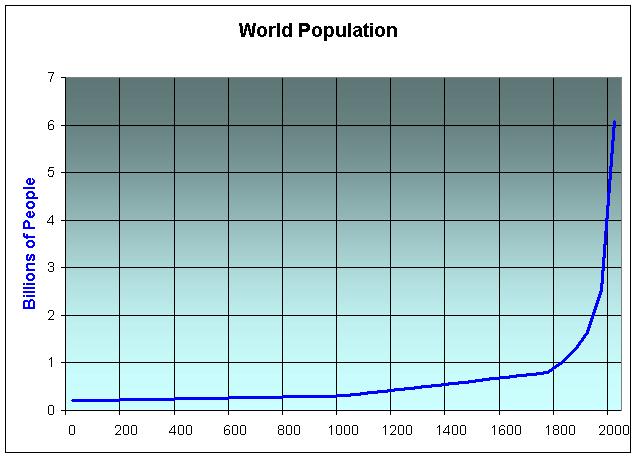 Although there has been a lot of controversy related to "the hockey stick graph", you cannot get "misled" by one if you understand its function and it is properly portrayed.
Because we are somewhere on this near vertical line related to our resources, population growth, debt and so on, things are happening very fast at this moment. The debt that was accumulated over the last 50 years could now be accumulated over lets say 5 years.
To understand the concept of exponential growth in more profound way, I advice you to either look at a video lecture from Dr. Albert Bartlett or read a transcript of it (the good thing with the version in text is that it can be translated).
One of the most compelling illustrations of this can be told in a little story followed a few questions.
An empty jar is placed on a table. At 11.00 one bacteria is inserted that has the capacity to double its numbers every minute. At 12.00 the jar is full.
- At what time is the jar half full?
- At what point in time would the bacteria in that jar realize that they are running out of space?
Lets assume that at 11.59 when the jar is half full the bacteria are starting to feel the urgency of the situation and gather whatever resources that they can find and somehow manages to come up with another three empty jars.
- At what time will these three empty jars be full? Well, at 12.01 jar one and two will be full and at 12.02 all four jars will be full.
This somewhat abstract story tells us something about why it is so important to understand exponential growth.
Because we are somewhere on this near vertical line related to our resources, population growth, debt and so on, things are happening very fast at this moment. The debt that was accumulated over the last 50 years could now be accumulated over lets say 5 years.
To understand the concept of exponential growth in more profound way, I advice you to either look at a video lecture from Dr. Albert Bartlett or read a transcript of it (the good thing with the version in text is that it can be translated).
One of the most compelling illustrations of this can be told in a little story followed a few questions.
An empty jar is placed on a table. At 11.00 one bacteria is inserted that has the capacity to double its numbers every minute. At 12.00 the jar is full.
- At what time is the jar half full?
- At what point in time would the bacteria in that jar realize that they are running out of space?
Lets assume that at 11.59 when the jar is half full the bacteria are starting to feel the urgency of the situation and gather whatever resources that they can find and somehow manages to come up with another three empty jars.
- At what time will these three empty jars be full? Well, at 12.01 jar one and two will be full and at 12.02 all four jars will be full.
This somewhat abstract story tells us something about why it is so important to understand exponential growth.
What got me started
One day about two years ago, I happened to end up on the website of Chris Martenson. I had never heard of the guy before but felt intrigued by his statement that "next twenty years are going to look very different from the last twenty". I checked out his series of videos called "the crash course" and had a strange feeling of wonder. The rather bold and shocking statements presented coupled with the facts of how our energy and economical systems are fundamentally flawed stirred an interest, almost a passion in me but did not leave me with the negative feelings you might expect. Perhaps it was that I just could not quite believe it, or maybe because I'm just prone to respond to this kind of information in a positive way.
The crash course is a good place to start and I urge you to take the time to watch it, but if you don't have the time it takes to watch the whole series there is a short version. I will make a short summary of the main points but will not come anyway near a full explanation.
The crash course follows three themes, economy, energy and environment. Problems in any of these areas alone can cause problems and have done so in the passed, but all three at the same time lay the grounds for something unlike anything that we have seen in the passed.
Economy - The crash course centers around the monetary system of the US, but can also be applied in part or wholly to other economies as well. The economic size of the US also makes what happens there relevant from a global perspective as well. The main point is DEBT. For many years, society has enabled an economic system that has allowed consumers to acquire enormous amounts of debt. But the debt stretches to a national level as well, where banks are creating money out of thin air by loaning it into existence.
Energy - Energy is what has enabled us to grow, in all ways. Of most importance here is oil. If you look at a chart of oil production over the last one hundred years it follows the growth in population almost perfectly. It has not only made it possible for us to multiply, but it has also raised our standard of living. Without it, there is no way to maintain the numbers or standard of living. Which brings us to the concept of peak oil. To make it simple, it is a point in time where we cannot continue increasing oil production. After this event oil production will decline but demand for oil will continue to rise. Most analysts agree that this will happen within the next five years, most likely withing the next two.
Environment - The same pattern as with peak oil can be applied to various natural resources such as uranium, coal, copper, phosphorus (commonly used in fertilizers). In an economy that is dependent on growth, these resources will be reaching their peak soon. (More on this also in peak everything)
These themes all have something in common, they grow exponentially. This means that something that started out as a slow growth will be growing faster and faster as time goes. The importance and the consequence of exponential growth is one of the most crucial things to grasp and needs a post of its own for explaining.
The crash course illustrates how unsustainable we are living today. It touches upon some of the outcomes that are a consequence of this unsustainable living. In a few words, things will be smaller and things will get ugly in the years to come.
The crash course is a good place to start and I urge you to take the time to watch it, but if you don't have the time it takes to watch the whole series there is a short version. I will make a short summary of the main points but will not come anyway near a full explanation.
The crash course follows three themes, economy, energy and environment. Problems in any of these areas alone can cause problems and have done so in the passed, but all three at the same time lay the grounds for something unlike anything that we have seen in the passed.
Economy - The crash course centers around the monetary system of the US, but can also be applied in part or wholly to other economies as well. The economic size of the US also makes what happens there relevant from a global perspective as well. The main point is DEBT. For many years, society has enabled an economic system that has allowed consumers to acquire enormous amounts of debt. But the debt stretches to a national level as well, where banks are creating money out of thin air by loaning it into existence.
Energy - Energy is what has enabled us to grow, in all ways. Of most importance here is oil. If you look at a chart of oil production over the last one hundred years it follows the growth in population almost perfectly. It has not only made it possible for us to multiply, but it has also raised our standard of living. Without it, there is no way to maintain the numbers or standard of living. Which brings us to the concept of peak oil. To make it simple, it is a point in time where we cannot continue increasing oil production. After this event oil production will decline but demand for oil will continue to rise. Most analysts agree that this will happen within the next five years, most likely withing the next two.
Environment - The same pattern as with peak oil can be applied to various natural resources such as uranium, coal, copper, phosphorus (commonly used in fertilizers). In an economy that is dependent on growth, these resources will be reaching their peak soon. (More on this also in peak everything)
These themes all have something in common, they grow exponentially. This means that something that started out as a slow growth will be growing faster and faster as time goes. The importance and the consequence of exponential growth is one of the most crucial things to grasp and needs a post of its own for explaining.
The crash course illustrates how unsustainable we are living today. It touches upon some of the outcomes that are a consequence of this unsustainable living. In a few words, things will be smaller and things will get ugly in the years to come.
My quest...

I say that I stumbled upon this information, and that is in part true. I had not intended to find what I found but I've always been the type of person that is looking for things that most other people are either ignoring, choosing not to find or just have not thought about finding.
Before talking more about my motives for sharing this information in the form of a blog, I would just briefly want to touch upon the general idea and subject that this blog will be revolving around. To use the expression of someone else "the next twenty years will be completely different from the past twenty years". Due to underlying structural problems in our society and the resources that it depends on, many things that we take for granted today will come to change. It will happen soon and it will happen fast. Knowing about them and accepting them as a likely outcome will get you one step further to being prepared. This is my belief as well as the belief of many others. It is important to remember though that these opinions in particular are not fact, but based on many facts that are available.
Since this information is not common knowledge and is presented in little to none of the media that most people come in contact with everyday, it is up to those that posses it to share it with others. Or is it?
I have known most of the things regarding this subject for about two years, and it is only now that I choose to actively try to pass it on to others. When trying to persuade, convince or show people that things are not as they seem, you are usually fighting a loosing battle. The score in the latest game of ice-hockey or football, who got voted out of lets dance or reading the memoirs of Justin Bieber are usually much more appealing things to follow than reading about what is happening in the world, especially after a hard day at work. For this reason I have chosen to focus my attention to those who are actively choosing to learn about these things, by for example reading this blog. I don't want to feel like a Jehovah's witness preaching to people who are not interested and just making them feel uncomfortable (however I might end up doing that anyway).
Whether people actually give a rats or not is irrelevant, I'm already aware that the vast majority do not have the attention-span to even read this far, and thats okay. But for those who do, I sincerely want to attract your attention and show you that you are better off learning about this sooner rather than later. Together we can build a network and perhaps, just perhaps we might end up making a difference...
Subscribe to:
Posts (Atom)